Innovation Fact of the Week
The $60 billion federal R&D funding shortfall
Beginning this week, ITIF will end the weekly update with a fact or data point about innovation. The Fact of the Week will provide a discrete snap shot of economic trends, technological advances, and historic data that we come upon in our research that strike as surprising, inspiring or even unsettling. We invite you to continue to read our reports and analyses and to attend our events. These facts will provide you something to think about, discuss and explore with others who are committed to advancing innovation.
Fact:
Growth in federal R&D investment from 1987-2008 was 0.3% per year, vs. 4.9% from 1953-1987, for a current annual shortfall of $60 billion.
Source:
National Science Board, Science and Engineering Indicators 2010.
Government funding for research played a key role in the technological breakthroughs that helped U.S. industry become global technology leaders World War II. Indeed, federal support of research grew 4.9% per year in inflation adjusted terms from 1953-1987. But with the decline of the Cold War and efforts at budget austerity, the federal government has abandoned its responsibilities to help fund research. Federal investments in research from 1987-2008 grew by only 0.3% per year, 15 times slower than in the prior era. If federal support had not lagged, current federal research funding would be $60 billion larger annually than it is today. Or another way to put this, we are short nearly nine National Science Foundations or twenty DARPAs. Other nations have done the opposite, ramping up their investments. From 1987 to 2008, R&D intensity increased substantially more in most other nations than the United States, including Japan (22 percent), Canada (31 percent), Sweden (34 percent), Ireland (75 percent), Korea (91 percent), Israel (110 percent), and China (110 percent). It's no wonder then, that the U.S. is falling behind in the race for global innovation advantage and losing the jobs related to that race.
May 28, 2011
change agents- 15 tips to consider
 Thanks to Rick of these
Fifteen Tips For Change Agents
by Rick BrennerBy now, most of us understand that leading a successful change effort is a difficult job. It can be a little easier, though, when we recognize that to change an organization, its people must see their roles in it differently. If we focus on the people, and how they change themselves, we do a lot better.
 f you're leading an organizational change effort, you'll have a chance to learn firsthand how difficult it can be. There's a lot of literature about change and change management. But change, even organizational change, happens one person at a time. Here are 15 tips about how people change. Keep them in mind, and you'll find the change leadership experience more rewarding and less frustrating.
 Quick clicks:
- Remember the Satir Change Model
- Think about organizations organically
- Expect backtracking
- Expect a loss of productivity at first
- Take small bites
- Not everyone "gets it" in the same way
- Not everyone "gets it" on your schedule
- People change for something better rather than to avoid something worse
- Processes are really just ideas
- You aren't in charge of anybody else's mind
- Welcome resistance
- People don't forget what they already know
- Change your change process
- Space your changes to avoid collisions
- Expect change to take longer than you expect
Remember the Satir Change Model
As we move through change, we move through a sequence of stages:| Old Status Quo | The initial state of the system, characterized by comfort, familiarity, established patterns, relationships and routines. |
| Foreign Element | In the midst of Status Quo, some element emerges that interferes with the continuation of the existing form. |
| Chaos | Once the Foreign Element is recognized and accepted, the system must abandon the Status Quo. It enters a regime characterized by anxiety, vulnerability and anger. Performance drops, sometimes dramatically. For a discusssion of the sense of Chaos following September 11, see "Now We're in Chaos," Point Lookout for September 19, 2001. |
| Integration | One or more Transforming Ideas emerge, and people begin to figure out how to integrate them into the system — how to work with the changed situation. |
| Practice | People practice interacting with the new reality. They need support and encouragement to sustain the change as they practice. |
| New Status Quo | Performance returns to previous levels, and may eventually exceed them. People establish new patterns, relationships and routines containing the Transforming Idea. |
Think about organizations organically
The word organization comes from the same root as the word organism, which is "a complex structure of interdependent and subordinate elements whose relationships and properties are largely determined by their function in the whole" [Webster's 9th, Merriam-Webster]. That is, in an organization, behavior cannot be understood in local terms. Everything interacts, and you can't understand it in linear terms. Linear thinking about organizations just doesn't work. And it's a good thing, too, because every successful change effort exploits the nonlinearities of organizational behavior. Every time we "build momentum" on the basis of a series of small victories, we're using a fundamental nonlinearity of organizations — that small wins multiply into bigger ones. Of course, it works the other way, too — small losses multiply into big ones.The problem is that we often expect organizations to respond to our change efforts linearly. For instance, we assume that if we follow some series of prescribed steps, we'll succeed. Or we assume that a cookbook procedure for organizational change exists. Or that some consultant knows all the answers. These kinds of approaches nearly always fail.
To succeed, think organically about organizations. Understand that their pieces interact to produce behaviors that are much more pronounced than any of the incremental changes you put in place. Use this force. It works.
Expect backtracking
Don't expect the organization to move smoothly from the Old Status Quo, through Chaos, into Integration, then Practice, and finally into New Status Quo. It almost never happens that way. There will be false starts and backtracking, and it's inevitable that things that you thought were buttoned down will come loose. Build it into your expectations, your schedule and your budget. To do otherwise is an exercise in fantasy.Expect a loss of productivity at first
When you kick off a change cycle, you're introducing a Foreign Element. Chaos inevitably follows. If you've planned the change well, the Transforming Idea is included in your change plan, and you can expect the period of Chaos to be as short as possible — but don't expect it to be shorter than possible. Expect some Chaos. And Chaos depresses productivity. Count on it.Take small bites
An organization — even an old, stodgy one — is a moving target. However well you think you understand the organization, don't take too long developing your change plan. By the time you get it implemented, the organization might have changed so much that the plan is obsolete. How long is too long? It depends on your organization. In a dynamic Internet startup, it could be that a week might be too long. For a company in a stable, old-economy industry, six months might be OK. It's best to start at the short end of the time scale, changing small things, until you have some experience and confidence that you can tackle larger projects.Not everyone "gets it" in the same way
Even though you've carefully designed your communications and training, you can't expect everyone to understand your message right away. Change managers who have a 100% coverage expectation have a tendency to blame the failure to attain 100% acceptance on the people who "don't get it." This is one way "resistance" takes hold. A blaming change effort leader helps create resistance. Instead, offer alternative ways to understand the change and its implications, and offer these ways in multiple formats. Live sessions, handouts, Web sites, webcasts, videos, and even CDs or podcasts for commuting time. Do as much as you can. It's much cheaper to offer multiple messages in multiple formats than to deal with resistance, or worse — to have to start all over again a year from now, having failed the first time. It would indeed be nice if one single approach worked for everyone you needed to reach, but we just don't live in that corner of the Universe.
 Not everyone "gets it" on your schedule
If you try to go faster than the people in the organization can, you risk creating unnecessary resistance. People get through Chaos at different rates. You can convey what you would like to have happen, but it's up to them to make it happen. Be flexible. Often, you might find it necessary to adapt your change plan as you discover what is actually happening in the organization.People change for something better rather than to avoid something worse
Threats are fine for determining behavior, but they just don't create real change. Here are two approaches that don't work: "You had better do this, or it's your job." "If we can't figure out how to do this, we'll be out of business." Instead, realize that lasting change comes from within — from the heart, from the spirit. To create lasting organizational change, you must develop a vision of a better work life — a vision that people can really believe in.Processes are really just ideas
Most change efforts require changes to organizational processes, and we have some great tools for representing processes. The tools are too good, though — we sometimes forget that processes have no physical manifestation. Processes are just ideas, and ideas exist only in our minds. So if a process is to change, what is in people's minds must change — their ideas about the processes, and how they, as people, relate to the processes and to each other.You aren't in charge of anybody else's mind
If change efforts require changes in processes, and processes are just ideas, then you'll probably be tempted to try to change other people's ideas. Resist the temptation. You can't change anybody else's mind — only they can. You can provide information, vision, motivation, education, training, incentives, opportunity, resources, support, compassion, and anything else someone might need as they go through change, but only they can actually execute the change. Trying to change someone else's mind for them makes about as much sense as doing their exercise program for them.Welcome resistance
Many change effort leaders feel that resistance is a bad thing, that it indicates failure to cooperate, or a poor change plan. It just isn't so. Resistance is wonderful. It shows that you're making some real progress. Resistance isn't actually resistance to change — it's resistance to the loss of the Old Status Quo. So when you see resistance, it means that people are sensing the loss of the Old Status Quo, which means that change has begun.Resistance isn't a problem — how we cope with resistance is often the problem. Make certain that your change plan accounts for resistance, and that you have a sense of where resistance will come from and what you can do about it.
People don't forget what they already know
Although we know quite a lot about how to show people new ways, very little is known about how to make people forget old ways. The old ways will stay with the organization, no matter how tightly you try to constrain — or coerce — people to follow new paths. This means that after you've educated everyone about the new ways of doing things, the old patterns are still there. And people are always free to fall back on the old ways. The only way to limit this behavior is to make the new ways so appealing and fun that people will choose them over the old ways. How you do that depends on what you're changing and on your particular organizational culture. That's one reason why cookbook change processes don't work. Every case is unique.
 Change your change process
If you get better at making changes in your organization, and if you keep at it, your organization will soon be a top performer. Why? So few organizations succeed at making lasting change, that it doesn't really take much to become a top performer. It looks like it takes a lot, because lasting change is so hard to do. To make change easier to do, invest first in getting better at changing things. For more, see Change How You Change.Space your changes to avoid collisions
If your organization is just beginning to move out of the Chaos of one change effort, and you zap it with a new Foreign Element from another change effort, you'll slow progress on the first change effort. Space things out to give the organization time to integrate and Practice previous changes. For more, see Piling Change Upon Change: Management Credibility.Expect change to take longer than you expect
Finally, recognize that in your own mind, you've already made the change. You've thought it through, and you know where you want things to go. But nobody else has — well, hardly anybody. Getting everyone to move to where they will want to go will take time. And we always underestimate how long it takes. Always. Top
TopThis document is http://www.chacocanyon.com/essays/tipsforchange.shtml
May 5, 2011
What if we could rethink and redesign agriculture? today!! now!!
The US Farm Bill will be debated again in 2012 and its time to begin the local and national discussion of what do we want from our food industry? how can it be organized? and even here locally in Jefferson County what would it take to move us from 4% local food consumption to 20% by 2020-- what would it take???
John Reganhold from WSU just printed a provocative article in SCIENCE magazine- a major international crops and soils scientist suggesting with his colleagues
Its the socio-political discussion not the science and technology that is the barrier to a sustainable food system-- read more:
Science magazine
http://www.news.ucdavis.edu/search/news_detail.lasso?id=9863
John Reganhold from WSU just printed a provocative article in SCIENCE magazine- a major international crops and soils scientist suggesting with his colleagues
Its the socio-political discussion not the science and technology that is the barrier to a sustainable food system-- read more:
Science magazine
http://www.news.ucdavis.edu/search/news_detail.lasso?id=9863
September 4, 2010
FIELD congrats!!
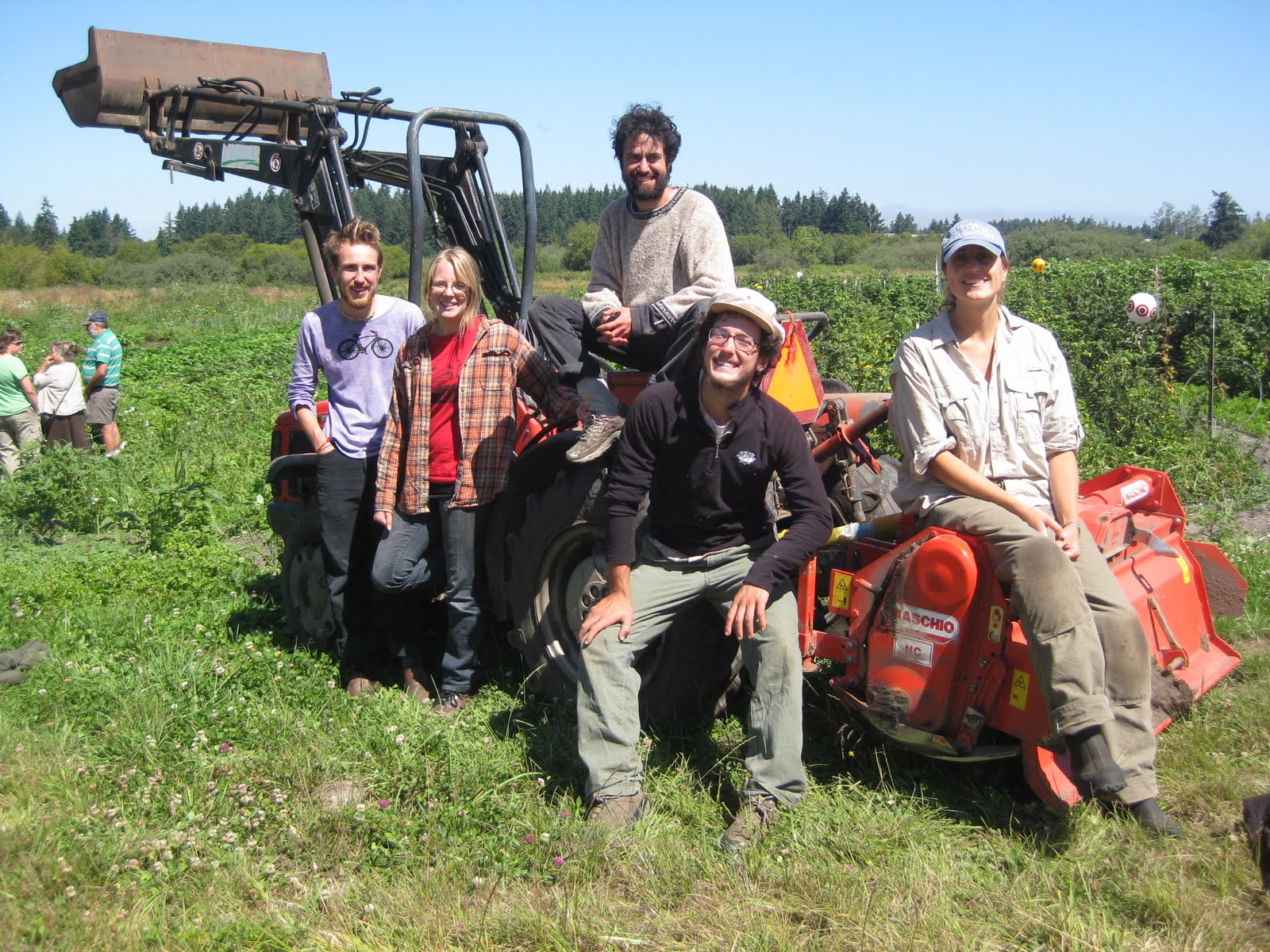
2010 Farm Interns for Education Leadership and Development
Jefferson County welcomes and needs a young generation of farmers. We welcome interns, graduates, entrepreneurs who want to learn from Master Farmers on the seven definitive micro-ecosystems that we have in our community. Thanks to our Master Farmers and interns!!
You've made this program much more than we ever expected!
September 3, 2010
Entrepreneurs- what makes them special
Anatomy of an Entrepreneur
Although entrepreneurs provide the majority of jobs in the United States, little is known about what makes them tick. The Anatomy of an Entrepreneur fills in some gaps by providing insights into high-growth founders' motivations, their socio-economic, educational, and familial backgrounds, as well as their views on the factors determining the success of start-ups.
A team of researchers led by Vivek Wadhwa of Duke University, Raj Aggarwal of the University of Akron, Krisztina Holly of the University of Southern California, and Alex Salkever of Duke University surveyed 549 company founders of successful businesses in high-growth industries, including aerospace, defense, computing, electronics, and health care. The findings are presented in the following two reports.
Family Background and Motivation
The Anatomy of an Entrepreneur: Family Background and Motivation provides insights into high-growth founders' motivations and their socio-economic, educational, and familial backgrounds.
Findings include:
More than 90 percent of the entrepreneurs came from middle-class or upper-lower-class backgrounds and were well-educated: 95.1 percent of those surveyed had earned bachelor's degrees, and 47 percent had more advanced degrees.
Seventy-five percent of the respondents ranked their academic performance among the top 30 percent of their high school classes, and 52 percent said they ranked among the top 10 percent. In college, 67 percent of the founders ranked among the top 30 percent of their undergraduate classes, and 37 percent ranked their performance among the top 10 percent.
Founders tended to be middle-aged—40 years old on average—when they started their first companies. Nearly 70 percent were married when they became entrepreneurs, and nearly 60 percent had at least one child, challenging the stereotype of the entrepreneurial workaholic with no time for a family.
Making of a Successful Entrepreneur
The Anatomy of an Entrepreneur: Making of a Successful Entrepreneur provides insight into company owners' views about what influences the success or failure of a startup business. Entrepreneurs identified prior work experience, learning from previous successes and failures, a strong management team, and good fortune as the most important factors in their success.
Findings include:
Professional networks were important to the success of their current businesses for 73 percent of the entrepreneurs. In comparison, 62 percent felt the same way about personal networks.
Only 11 percent of the first-time entrepreneurs received venture capital, and 9 percent received private/angel financing. Of the overall sample, 68 percent considered availability of financing/capital as important. Of the entrepreneurs who had raised venture capital for their most recent businesses, 96 percent considered financing important.
Eighty-six percent of Ivy-League graduates ranked university education as important, as compared with 70 percent of the overall sample. Only 20 percent of entrepreneurs and 18 percent of Ivy-League graduates ranked university education as extremely important.
Most company founders (86 percent) ranked state or regional assistance as slightly or not at all important.
In identifying barriers to entrepreneurial success, the most commonly named factor – by 98 percent of respondents – was lack of willingness or ability to take risks. Other barriers cited by respondents were the time and effort required (93 percent), difficulty raising capital (91 percent), business management skills (89 percent), knowledge about how to start a business (84 percent), industry and market knowledge (83 percent), and family/financial pressures to keep a traditional, steady job (73 percent).
Although entrepreneurs provide the majority of jobs in the United States, little is known about what makes them tick. The Anatomy of an Entrepreneur fills in some gaps by providing insights into high-growth founders' motivations, their socio-economic, educational, and familial backgrounds, as well as their views on the factors determining the success of start-ups.
A team of researchers led by Vivek Wadhwa of Duke University, Raj Aggarwal of the University of Akron, Krisztina Holly of the University of Southern California, and Alex Salkever of Duke University surveyed 549 company founders of successful businesses in high-growth industries, including aerospace, defense, computing, electronics, and health care. The findings are presented in the following two reports.
Family Background and Motivation
The Anatomy of an Entrepreneur: Family Background and Motivation provides insights into high-growth founders' motivations and their socio-economic, educational, and familial backgrounds.
Findings include:
More than 90 percent of the entrepreneurs came from middle-class or upper-lower-class backgrounds and were well-educated: 95.1 percent of those surveyed had earned bachelor's degrees, and 47 percent had more advanced degrees.
Seventy-five percent of the respondents ranked their academic performance among the top 30 percent of their high school classes, and 52 percent said they ranked among the top 10 percent. In college, 67 percent of the founders ranked among the top 30 percent of their undergraduate classes, and 37 percent ranked their performance among the top 10 percent.
Founders tended to be middle-aged—40 years old on average—when they started their first companies. Nearly 70 percent were married when they became entrepreneurs, and nearly 60 percent had at least one child, challenging the stereotype of the entrepreneurial workaholic with no time for a family.
Making of a Successful Entrepreneur
The Anatomy of an Entrepreneur: Making of a Successful Entrepreneur provides insight into company owners' views about what influences the success or failure of a startup business. Entrepreneurs identified prior work experience, learning from previous successes and failures, a strong management team, and good fortune as the most important factors in their success.
Findings include:
Professional networks were important to the success of their current businesses for 73 percent of the entrepreneurs. In comparison, 62 percent felt the same way about personal networks.
Only 11 percent of the first-time entrepreneurs received venture capital, and 9 percent received private/angel financing. Of the overall sample, 68 percent considered availability of financing/capital as important. Of the entrepreneurs who had raised venture capital for their most recent businesses, 96 percent considered financing important.
Eighty-six percent of Ivy-League graduates ranked university education as important, as compared with 70 percent of the overall sample. Only 20 percent of entrepreneurs and 18 percent of Ivy-League graduates ranked university education as extremely important.
Most company founders (86 percent) ranked state or regional assistance as slightly or not at all important.
In identifying barriers to entrepreneurial success, the most commonly named factor – by 98 percent of respondents – was lack of willingness or ability to take risks. Other barriers cited by respondents were the time and effort required (93 percent), difficulty raising capital (91 percent), business management skills (89 percent), knowledge about how to start a business (84 percent), industry and market knowledge (83 percent), and family/financial pressures to keep a traditional, steady job (73 percent).
the best gift!!!! ted.com
Check these out. . . and enjoy!!!
"The Best Stats You've Ever Seen"
http://www.ted.com/talks/hans_rosling_shows_the_best_stats_you_ve_ever_seen.html
(population growth, health and wealth)
Stewart Brand "Power of Cities"
http://www.ted.com/talks/stewart_brand_proclaims_4_environmental_heresies.html
(note segment on population sink at minute 7:43)
"The Best Stats You've Ever Seen"
http://www.ted.com/talks/hans_rosling_shows_the_best_stats_you_ve_ever_seen.html
(population growth, health and wealth)
Stewart Brand "Power of Cities"
http://www.ted.com/talks/stewart_brand_proclaims_4_environmental_heresies.html
(note segment on population sink at minute 7:43)
3,000 year old technology is new innovation under your sink!
DIGESTERS PRODUCE ENERGY, FERTILIZER AND CUT WASTE
Small changes can make a big difference, and that’s the idea behind a small-size anaerobic digester that WSU researcher Chad Kruger presented to a group of congressional staffers visiting the WSU Pullman campus earlier this month.
For the complete story read WSU Today online http://www.wsutoday.wsu.edu/pages/publications.asp?Action=Detail&PublicationID=21045&TypeID=1
Small changes can make a big difference, and that’s the idea behind a small-size anaerobic digester that WSU researcher Chad Kruger presented to a group of congressional staffers visiting the WSU Pullman campus earlier this month.
For the complete story read WSU Today online http://www.wsutoday.wsu.edu/pages/publications.asp?Action=Detail&PublicationID=21045&TypeID=1
Higher ed options in Jefferson County

Peninsula daily news- Sep 3, 2010
Partnership with Vermont college may lead to full degrees for Jefferson County students
By Charlie Bermant Peninsula Daily News
PORT TOWNSEND -- The offering of academic programs in Jefferson County that range from associate degrees to graduate degrees is within reach, the Jefferson County Higher Education Committee was told Thursday.
Goddard College, a liberal arts college in Plainfield, Vt., that offered a limited graduate degree program at Fort Worden State Park since 2002, is considering expanding its undergraduate offerings.
The move would turn its facility at Fort Worden, which it shares with Peninsula, into a West Coast campus for Goddard.
The idea was discussed at the monthly meeting of the Jefferson County Higher Education Committee, at which Peninsula College President Tom Keegan addressed about 20 people that includes representatives of Jefferson County Library, Port Townsend city, Washington State University and the Port of Port Townsend.
Keegan said that Goddard's offering of undergraduate degrees would provide a bridge between the associate's degree programs offered by Peninsula and the graduate degree programs offered by Goddard.
This expansion of local educational options would eliminate the need for local students to leave the area to get a complete education, and help Peninsula College satisfy a broader mission, he said.
"We are citizens of the world," Keegan said. "We must provide our students the skills they need to function in the global economy."
Port Townsend Planning Director Rick Sepler said that "the idea that we would become Goddard's West Coast campus is exciting.
The expansion of Goddard College is still in the preliminary stage, he said.
The possibility will be examined at a Port Townsend City Council work study session at 6 p.m. Sept. 13 in its chambers at 540 Water St.
Keegan visited Port Townsend after a three-day meeting in Olympia where he learned that colleges are facing cuts of up to 30 percent in the next few years.
The good news is that when the economy recovers, the need for retraining will increase, Keegan said, but the bad news is that the education needed will evolve into an unpredictable area.
Twenty years ago, Peninsula College offered courses in the now-lost craft of typewriter repair.
Computer repair was a popular course for a time, but "it is now cheaper to buy a new computer than to repair it," he said.
Today's needed trades have to do with network diagnostics and repair, but that could change.
As a result, faculty members are in the greatest need of retraining, Keegan said.
Keegan said that, statistically, a child who is 8 years old now will hold 14 career-path jobs before reaching his or her mid-thirties.
"Can anyone tell me what we need teach them?" he asked.
"Flexibility," said Jefferson County Commissioner John Austin.
"Critical thinking," said Lela Hilton, Clemente Course program director.
Keegan said the competition for students at brick-and-motor schools among Peninsula College and neighboring schools such as Olympic College -- which operates in Poulsbo and Bremerton -- is a thing of the past.
Instead, competition between schools is intense online.
Online classes offer convenience and variety, expanding offerings and making it possible to complete courses around the clock, he said.
Within this context, community colleges still can provide a needed personal service, Washington State University Extension Executive Director Katherine Baril said.
"As more people go online, they will need a third space where people come together for personal contact where they can better understand their educational choices," she said.
________
Jefferson County Reporter Charlie Bermant can be reached at 360-385-2335 or charlie.bermant@peninsuladailynews.com.
All materials Copyright © 2010 Horvitz Newspapers.

Entrepreneurs Keep the Local Food Movement Hot
Local food businesses play a much more critical role in economic development than commonly thought
By John Tozzi
Entrepreneurs are flocking to local food, starting businesses devoted to producing and delivering food within their communities. Just as consumers focus new attention on what we eat and where it comes from, farmers, foodmakers, restaurateurs, retailers, distributors, and processors are rethinking the business models behind it. They want to create enterprises that will succeed in the long run for local food to be more than just a fad or a luxury for wealthy Western consumers.
A report, "Community Food Enterprise: Local Success in a Global Marketplace," spotlights 24 ventures around the world that are pioneering models for local food.They range from the sprawling Organic Valley farmer co-operative, which ships more than $500 million in dairy and other products annually, to a caterer in Zambia that has branched out to selling processed food and equipment. The examples include private companies, co-ops, and nonprofits. Whatever the form, all the enterprises are locally controlled and aim to be sustainable business operations, not dependent on grants or government subsidies.
The 190-page report, funded by the Bill & Melinda Gates Foundation and the W.K. Kellogg Foundation, highlights the role local food businesses play in economic development—creating jobs and bringing money into a community.Michael Shuman, an economist at the Business Alliance for Local Living Economies and co-author of the report, sees economic development intertwined with developing local food systems.For example, the Appalachian Harvest Network in the Appalachian region of Virginia and Tennessee helps mostly poor former tobacco farmers switch to growing organic fruits and vegetables for specialty stores and grocers, replacing a shrinking market with a growing one.Likewise, researchers found that the majority of the small farms that sell their crops at New York City's green markets could not survive without the access to the city's customers that the program provides.
By John Tozzi
Entrepreneurs are flocking to local food, starting businesses devoted to producing and delivering food within their communities. Just as consumers focus new attention on what we eat and where it comes from, farmers, foodmakers, restaurateurs, retailers, distributors, and processors are rethinking the business models behind it. They want to create enterprises that will succeed in the long run for local food to be more than just a fad or a luxury for wealthy Western consumers.
A report, "Community Food Enterprise: Local Success in a Global Marketplace," spotlights 24 ventures around the world that are pioneering models for local food.They range from the sprawling Organic Valley farmer co-operative, which ships more than $500 million in dairy and other products annually, to a caterer in Zambia that has branched out to selling processed food and equipment. The examples include private companies, co-ops, and nonprofits. Whatever the form, all the enterprises are locally controlled and aim to be sustainable business operations, not dependent on grants or government subsidies.
The 190-page report, funded by the Bill & Melinda Gates Foundation and the W.K. Kellogg Foundation, highlights the role local food businesses play in economic development—creating jobs and bringing money into a community.Michael Shuman, an economist at the Business Alliance for Local Living Economies and co-author of the report, sees economic development intertwined with developing local food systems.For example, the Appalachian Harvest Network in the Appalachian region of Virginia and Tennessee helps mostly poor former tobacco farmers switch to growing organic fruits and vegetables for specialty stores and grocers, replacing a shrinking market with a growing one.Likewise, researchers found that the majority of the small farms that sell their crops at New York City's green markets could not survive without the access to the city's customers that the program provides.
Innovation- plant trees
In Montreal the city plants 100,000 new trees each year. . they started in the l900s when Olmsted designed the City's park system and wrote in his journal: "Now i have given the city its lungs".
Portland ‘Treebates’ now help city stormwater programs branch out. New intiative encourages property owners to plant thousands of new trees
Portland ‘Treebates’ now help city stormwater programs branch out. New intiative encourages property owners to plant thousands of new trees
Subscribe to:
Posts (Atom)
